9-Bell and 4-Bell Clocks: What Makes These Chiming Clocks So Special?
There is something completely different about a real chiming clock.
Not a tiny electronic speaker. Not a battery-powered melody pretending to be bells. A true mechanical chiming clock has presence. You hear the movement working, the hammers lifting, the bells responding, and the case itself helping shape the sound.
Among the most interesting examples are 4-bell and 9-bell clocks. These clocks are admired by collectors because they offer more than simple timekeeping. They bring music, mechanics, history, and craftsmanship together in one beautiful piece.
But what exactly is the difference between a 4-bell clock and a 9-bell clock?
What Is a 4-Bell Clock?
A 4-bell clock is generally a mechanical chiming clock that uses four tuned bells to play a melody, most commonly the Westminster chime.
Westminster is the classic quarter-hour melody many people associate with traditional mantel clocks, bracket clocks, and historic tower clocks. On many 4-bell clocks, the melody builds throughout the hour.
At the first quarter, you hear a short phrase.
At the half hour, the melody continues.
At the three-quarter hour, more of the sequence plays.
At the top of the hour, the full Westminster chime plays, followed by the hour strike.
That gradual build is part of the charm. The clock does not simply announce the hour. It marks the passage of time throughout the day in a musical way.
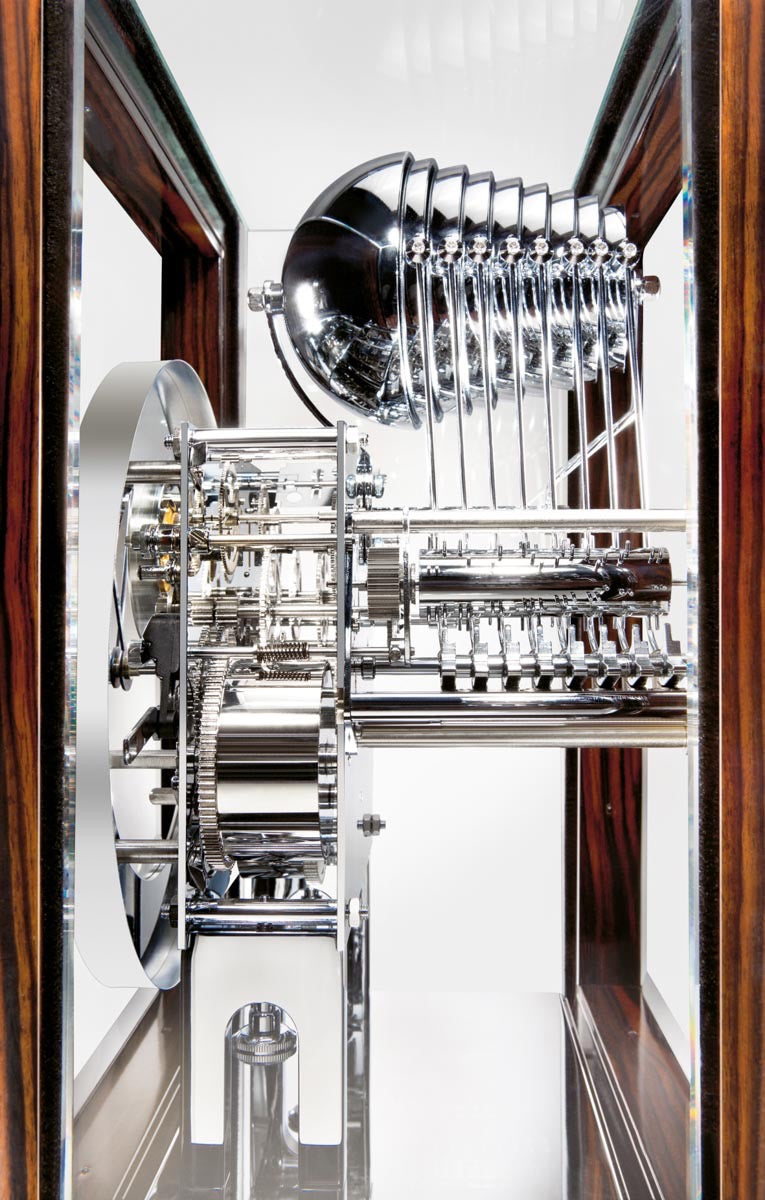
Four-bell clocks are especially attractive when the bells are visible. Watching the hammers lift and fall gives the clock a wonderful mechanical personality.
What Is a 9-Bell Clock?
A 9-bell clock is a more complex and often more impressive chiming clock. Instead of four bells, the clock uses nine tuned bells to create a richer and more varied musical sound.
Many 9-bell clocks are associated with triple-chime movements. These often allow the owner to select from three classic melodies:
Westminster
Whittington
St. Michael
That selection is one of the biggest reasons collectors love them. A 9-bell clock gives the owner more variety and a fuller musical experience than a typical 4-bell Westminster clock.
The sound is usually deeper, more layered, and more dramatic. With more bells available, the movement can create a more complex chime sequence and a more impressive musical effect.
Westminster, Whittington, and St. Michael Chimes
The Westminster chime is the most familiar. It is elegant, orderly, and instantly recognizable.
Whittington has a more old-world English character. It is less common than Westminster, and many collectors enjoy it because it feels more distinctive.
St. Michael has its own stately charm. It is often found on better triple-chime clocks and gives the clock a refined, historic feel.
When a clock offers all three, it gives the owner the ability to change the personality of the clock without changing the clock itself. Some people keep Westminster on most of the time. Others prefer Whittington or St. Michael because they are less common and feel more special.
4-Bell vs 9-Bell: Which Is Better?
One is not automatically better than the other. They simply offer different experiences.
A 4-bell clock can be elegant, refined, and charming. It gives you the classic mechanical chime experience in a simpler and often more compact form.
A 9-bell clock is usually more dramatic. It has more musical range, more mechanical complexity, and often a more impressive sound. These clocks tend to appeal to collectors who want something a little more special than a standard Westminster chime clock.
In simple terms:
A 4-bell clock is charming and classic.
A 9-bell clock is grand, musical, and more complex.
Why Collectors Care About the Bell Count
Collectors care because the bell count says a lot about the clock.
More bells usually mean a more complicated movement, more hammers, more adjustments, and more craftsmanship. It also means there is more that must be working correctly for the clock to perform as intended.
That is why condition matters so much.
A beautiful 9-bell clock that does not chime correctly may still be desirable, but it is a project. A properly working 9-bell clock is a very different thing. When the timing, chime sequence, strike, silence feature, and melody selector all work as they should, the clock becomes far more impressive.
The same is true for 4-bell clocks. The bells should sound clear, the hammers should land properly, and the Westminster sequence should play correctly through the quarters.
A Note About “4/4 Westminster”
You may see the phrase “4/4 Westminster” when looking at mechanical clocks. This refers to a clock that plays the Westminster chime through the four quarters of the hour.
That does not always mean the clock is a 4-bell clock.
In other words, “4/4 Westminster” describes the chime pattern. “4-bell” describes the bell arrangement.
They are related, but they are not always the same thing.
What to Look for When Buying a 4-Bell or 9-Bell Clock
When considering a chiming clock, pay close attention to a few key things.
Does the clock run and keep time?
Does the chime play at each quarter hour?
Does the hour strike match the correct hour?
Do all bells sound clearly?
Does the chime selector work properly?
Does the silence or night shutoff feature work, if equipped?
Has the clock been recently serviced or tested?
A clock can look incredible and still need mechanical attention. That does not necessarily make it a bad clock. It simply means the buyer should understand what is working, what is not, and what may need service.
The Beauty of Mechanical Sound
The appeal of a 4-bell or 9-bell clock is not only in the case, dial, or brand. It is in the experience.
These clocks bring sound into the home in a way few objects can. They mark time with ceremony. They make a room feel warmer, older, and more alive.
A 4-bell clock gives you the charm of a classic mechanical chime.
A 9-bell clock gives you a fuller musical performance.
Both remind us that clocks were never just about telling time. At their best, they were designed to be heard, admired, maintained, and passed on.
For collectors and clock lovers, that is what makes them special.
Shop 4-Bell Clocks:

Just A Clock Collector