How to Identify a Howard Miller Clock: Model Numbers, Serial Numbers, Date Codes and Movements
Howard Miller has produced wall clocks, mantel clocks, bracket clocks, floor clocks, alarm clocks and decorative timepieces for generations. With so many models made over such a long period, identifying an inherited or secondhand Howard Miller clock is not always as easy as reading the name on the dial.
The clock may have a paper or foil label showing its model and serial number. The label may be faded, damaged or missing entirely. Even when several numbers are visible, it may not be clear which one identifies the clock and which one belongs only to the movement inside it.
A Howard Miller clock can contain several completely different identifiers:
The Howard Miller model number identifies the complete clock.
The serial number identifies the individual clock or production record.
The movement number identifies the mechanism operating inside the case.
A date code or production mark may help estimate age, but it must be interpreted carefully.
A patent number, copyright date or inspection mark may have little connection to the year the complete clock was assembled.
Understanding these differences is the key to identifying a Howard Miller clock correctly.
START WITH THE HOWARD MILLER MODEL NUMBER
The model number is normally the most useful piece of information when identifying the complete clock.
Many Howard Miller clock model numbers appear in a three-digit, hyphen, three-digit format, such as:
612-300
613-244
630-146
635-171
The model number refers to the complete Howard Miller clock, including its case design, dial, movement configuration and original features.
This is the number you should search first when trying to locate:
The original model name
Catalog descriptions
Clock dimensions
Wood finish
Movement type
Chime features
Approximate production period
Original photographs
Replacement instructions
Previously sold examples
Search the complete number with the hyphen and quotation marks when possible. For example:
“Howard Miller 630-146”
Searching the exact model number is usually more effective than searching a general description such as “Howard Miller wooden mantel clock.”
WHERE TO FIND THE MODEL AND SERIAL NUMBER
The location of the label depends partly on the type of clock.
Howard Miller mantel and bracket clocks
Begin by inspecting:
The back of the case
The bottom of the case
The inside surface of the rear access door
The inside of the front door
The interior backboard
The underside of a removable base
A label may be made from paper, foil or another adhesive material. On older clocks, it may have darkened until it blends into the wood.
Do not overlook a damaged label. Even a partial model number can narrow the search significantly.
Howard Miller wall clocks
Inspect:
The backboard
The lower back of the case
The inside of the front door
The area behind or below the movement
The interior of the lower pendulum compartment
The underside of the case
Remove the clock from the wall carefully before examining it. Do not attempt to read a label while supporting a heavy clock with one hand.
Howard Miller floor and grandfather clocks
Howard Miller advises checking several possible locations on a floor clock:
A label on the back of the clock
A foil label inside the front door
An inside rail when the clock does not have a front-opening door
The inside of the back panel behind the movement
A flashlight may be necessary to see a label behind the movement or high inside the case.
Do not reach into the movement or disturb the chime components while searching. Access panels should be removed carefully and returned to their proper positions.
MODEL NUMBER VERSUS SERIAL NUMBER
The model and serial numbers serve different purposes.
The model number
The model number identifies the clock design or product.
Multiple clocks of the same model can therefore have the same model number.
For example, every clock produced as a particular Howard Miller model may share the same six-digit model designation, while each individual clock has a different serial number.
The serial number
The serial number is associated with the individual clock or its manufacturing record.
A serial number can be useful when contacting the manufacturer, researching production records or distinguishing one example from another. However, it should not automatically be treated as a publicly decodable date.
There is no single serial-number formula that can safely determine the production year of every Howard Miller clock from every era.
Numbering systems, label designs and manufacturing practices can change. A decoding method that appears to work for one period may not apply to another.
Use the serial number as supporting evidence rather than forcing it into an unverified formula.
THE NUMBER ON THE MOVEMENT IS NOT THE CLOCK MODEL NUMBER
This is one of the most common identification mistakes.
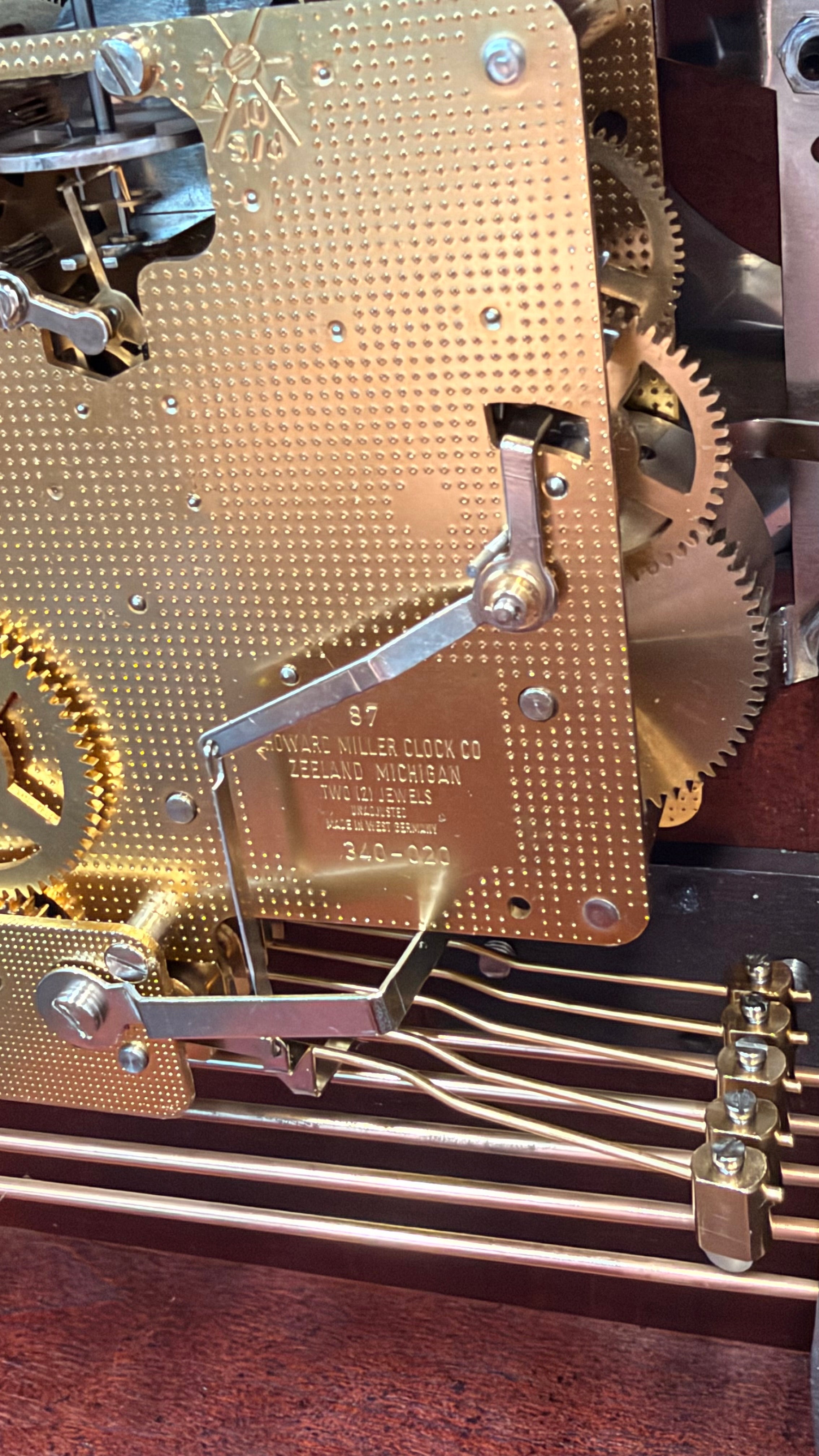
A mechanical Howard Miller clock may contain a movement made by another clock-movement manufacturer. Numbers stamped into the movement’s brass back plate identify that mechanism—not necessarily the complete Howard Miller clock.
For example, a clock may have:
Howard Miller model number: 630-146
Movement number: Hermle 340-020A
Both numbers are important, but they identify different things.
Searching only for “340-020A clock” will primarily return information about the Hermle movement series. It may not reveal which Howard Miller case surrounds it.
Likewise, a movement can appear in clocks sold by several different cabinet manufacturers. The movement number alone may therefore produce many clocks that look nothing like yours.
When available, use the Howard Miller model number to identify the clock and the movement number to identify its mechanical specifications.
HOW TO FIND THE MOVEMENT NUMBER
The movement number is commonly stamped or engraved into the back plate of a mechanical clock movement.
To locate it, open the rear access door or carefully remove the appropriate access panel. Look at the large brass plate behind the clock dial.
The back plate may show:
The movement manufacturer’s name or trademark
A movement series number
A pendulum-length marking
A chime designation
Jewels or escapement information
A country-of-origin marking
A production code
A patent or design number
Additional letters or suffixes
Take one clear photograph of the entire back plate before taking close-ups. A photograph showing only one number may leave out important markings needed to understand it.
Do not remove the movement merely to photograph it. Most movement markings can be documented through the normal rear or side access opening.
WHO MADE THE MOVEMENT INSIDE A HOWARD MILLER CLOCK?
The Howard Miller name on the dial identifies the finished clock brand. It does not always identify the company that manufactured the internal mechanism.
Depending on the clock’s age and design, a mechanical Howard Miller clock may contain a movement associated with manufacturers such as:
Hermle
Kieninger
Urgos
Other German, American or imported movement suppliers
Some movements display a complete name. Others use trademarks or initials.
Hermle movements may show names or markings such as Franz Hermle, FHS or a Hermle trademark.
Kieninger movements generally display the Kieninger name or trademark along with the movement series.
Urgos movements may show the Urgos name, trademark or UW-series markings.
Howard Miller acquired Kieninger in 1993, but that does not mean every Howard Miller clock contains a Kieninger movement. Howard Miller clocks have used different movement suppliers and configurations throughout the company’s history.
The movement manufacturer, series and exact suffix should all be recorded before searching for parts or replacement options.
WHY THE COMPLETE MOVEMENT NUMBER MATTERS
A partial movement number is not always enough.
Two movements may belong to the same basic series but differ in:
Chime configuration
Hammer arrangement
Pendulum length
Hand-shaft length
Automatic night shutoff
Chime or strike sequence
Mounting location
Cable-driven or chain-driven construction
Spring-driven or weight-driven operation
Other mechanical features
Letters appearing after a movement number can also matter.
For example, 340-020 and 340-020A should not automatically be assumed to be identical merely because the main numbers match.
When documenting a movement, copy every number, letter and symbol exactly as it appears.
CAN A HOWARD MILLER CLOCK BE DATED BY ITS MOVEMENT?
The movement may provide a useful age clue, but its date should not automatically be presented as the exact manufacturing date of the finished clock.
A movement could have been manufactured before the clock was assembled.
It could have remained in inventory before being installed.
It may have been replaced later in the clock’s life.
A movement-production code therefore tells you something about the movement. It may help establish an earliest possible date or general period for the clock, but it is not always conclusive by itself.
This distinction is particularly important when a newer replacement movement has been installed in an older case.
In that situation, the case, dial, label and model may be older than the movement currently operating the clock.
HOW TO ESTIMATE THE AGE OF A HOWARD MILLER CLOCK
The most reliable approach is to combine several pieces of evidence.
1. Examine the original product label
Record the model number, serial number and every other visible code.
Photograph the complete label before attempting to clean it. Moisture or cleaning products can permanently damage old paper labels and remove already-faded printing.
2. Search the exact model number
Search the number both with and without the hyphen.
Try combinations such as:
“Howard Miller 612-300”
“Howard Miller model 612-300”
“Howard Miller 612-300 catalog”
“Howard Miller 612-300 manual”
A catalog appearance can establish that the model was available by a particular year. A discontinued catalog appearance can also help narrow its likely production period.
3. Inspect the movement
Record the movement maker, full model number and all date-related markings.
The movement may help determine whether the clock is consistent with a particular period, but remember that it could be a later replacement.
4. Look for original paperwork
Useful documents can include:
Sales receipts
Warranty cards
Instruction manuals
Registration documents
Gift inscriptions
Dealer paperwork
Shipping labels
Original cartons
An original dated receipt is generally stronger evidence than an age estimate based only on styling.
5. Compare the clock with period catalogs
Compare more than the general case shape.
Look closely at:
Dial design
Hands
Bezel
Door shape
Finials
Pendulum
Weights
Glass panels
Wood finish
Movement features
Chime selector
Moon dial
Decorative trim
Howard Miller occasionally used similar case designs across multiple models, finishes or movement configurations. A close match is more useful than a clock that merely has a similar arch or wood color.
WHAT DOES A LETTER DATE CODE MEAN?
Some Howard Miller clocks, labels or components may contain a separate letter, stamped character or abbreviated production marking.
Treat these markings cautiously.
A letter may represent:
A production year
A factory code
A finish designation
An inspection mark
A batch
An internal manufacturing reference
A component code
Its meaning may depend on the clock’s period and the type of label on which it appears.
Do not use a date-code chart unless you can confirm that it applies to the same Howard Miller labeling system and manufacturing era as your clock.
The strongest identification combines the code with the model number, serial number, catalog evidence, movement information and any original paperwork.
COPYRIGHT DATES AND PATENT NUMBERS CAN BE MISLEADING
A printed copyright date is not necessarily the date your clock was produced.
Instruction sheets, labels and packaging designs may continue to be used for years after the printed material was copyrighted.
Similarly, a patent date tells you when a design or invention was protected. It does not prove that the clock itself was manufactured in that year.
Other numbers that may be mistaken for the model number include:
Movement patent numbers
Dial-part numbers
Pendulum numbers
Inspection stamps
Cabinet-part numbers
Quartz movement numbers
Label-printing codes
Numbers written by a repairer
Always identify where the number appears before deciding what it represents.
WHAT TO DO WHEN THE HOWARD MILLER LABEL IS MISSING
A missing label makes identification more difficult, but not necessarily impossible.
Begin by photographing the clock thoroughly.
Useful photographs include:
The complete front of the clock
The full back of the case
Both sides
The top and bottom
The dial and hands
The movement’s complete back plate
The pendulum
The weights
The key or crank
The chime rods or chime tubes
The inside of the case
Any stamps, labels, signatures or handwritten marks
Any damaged or altered areas
Photograph the clock straight-on rather than only from decorative angles. Clear identification photographs are different from sales photographs.
Then record:
Overall height, width and depth
Case material and finish
Mechanical or quartz operation
Number of winding holes
Number of weights
Available chime melodies
Presence of a moon dial
Automatic night shutoff
Pendulum style
Any model or movement numbers
Use these details together when searching.
A phrase such as “Howard Miller cherry mantel clock” may return hundreds of results.
A more specific search such as “Howard Miller arched cherry mantel clock triple chime moon dial Kieninger” has a better chance of finding the correct model.
USE PREVIOUSLY SOLD CLOCKS AS AN IDENTIFICATION ARCHIVE
Previously sold listings can be valuable even when the clock is no longer available.
A detailed archived listing may preserve:
The model name
Model number
Movement number
Case dimensions
Original features
Chime melodies
Collection name
Photographs of the label or movement
Approximate age
The archived clock must still be compared carefully. Howard Miller sometimes produced visually similar clocks with different movements, finishes or model numbers.
Do not identify a clock solely because the front appears similar in one photograph.
Compare the label, dimensions, dial, hardware, movement and case details whenever possible.
COMMON HOWARD MILLER IDENTIFICATION MISTAKES
Searching the movement number as the finished clock model
A Hermle or Kieninger number identifies the mechanism. It may not identify the Howard Miller case.
Assuming the serial number is the model number
The model number is shared by clocks of the same model. The serial number identifies the individual example or production record.
Treating the movement date as the clock’s exact age
The movement may predate assembly or may have been replaced.
Assuming the dial name identifies the movement maker
Howard Miller may appear on the dial while another manufacturer’s name appears on the internal movement.
Using one front photograph
Many Howard Miller clocks share similar arches, columns, dials and wood finishes. The back, label and movement are often more useful than the front.
Ignoring letters after the movement number
A suffix may identify an important variation.
Assuming every old Howard Miller clock is antique
Howard Miller was founded in 1926. A clock can be vintage and collectible without being at least 100 years old.
Assuming every German movement is interchangeable
Movements that look similar may differ in dimensions, pendulum requirements, hammer layout, chime configuration and mounting.
IDENTIFY THE CLOCK BEFORE ORDERING A REPLACEMENT MOVEMENT
Do not purchase a replacement based only on the Howard Miller model number or only on a partial movement number.
For a quartz clock, the finished clock model may be used in a manufacturer’s movement cross-reference system.
For an older mechanical clock, identification usually requires more detailed movement information, including:
Complete movement number
Manufacturer
Any suffix letters
Pendulum-length marking
Hand-shaft configuration
Chime type
Hammer location and arrangement
Mounting dimensions
Cable, chain or spring operation
A movement that physically fits the opening may still be incorrect if its hand shaft, pendulum, chime rods, hammer arrangement or operating features differ.
Whenever possible, compare the original movement with the proposed replacement carefully before ordering.
Browse available genuine Hermle clock movements and Kieninger clock movements by their complete movement numbers and specifications.
DOES THE MODEL NUMBER DETERMINE THE CLOCK’S VALUE?
Identification is the starting point for determining value, not the final answer.
Once the exact model has been identified, consider:
Condition of the case
Condition of the dial and glass
Originality
Movement type
Operating condition
Chime features
Completeness
Included pendulum, weights, key or crank
Rarity
Buyer demand
Evidence of repairs or replacement parts
Quality of the movement
A model number may help locate comparable clocks, but an asking price does not establish actual value.
Compare genuinely similar clocks and account for differences in condition, completeness, operation, shipping and seller support.
For a more complete explanation, read What Makes a Vintage Clock Valuable?.
FREQUENTLY ASKED QUESTIONS
Where is the model number on a Howard Miller clock?
Check the back, bottom, inside the door, interior backboard and areas near the movement. On a floor clock, the label may also be on an inside rail or behind the movement.
What does a Howard Miller model number look like?
Many models use a three-digit, hyphen, three-digit format, such as 630-146 or 612-300. Other identifiers may use different formats, so confirm that the number appears on the clock’s product label.
Is the movement number the same as the model number?
No. The Howard Miller model number identifies the finished clock. A Hermle, Kieninger or Urgos number stamped on the back plate identifies the internal movement.
Can I determine the year from the serial number?
Sometimes a serial number or associated code may help narrow the production period, but there is no single public formula that safely dates every Howard Miller clock. Confirm the result with labels, catalogs, movement information and paperwork.
Does the movement date tell me when the clock was made?
Not necessarily. The movement may have been manufactured before final assembly or replaced later.
What if my Howard Miller clock has no label?
Photograph the complete clock, dial, movement, pendulum, weights and case. Record the dimensions and movement markings, then compare those details with catalogs and documented examples.
Can two Howard Miller clocks look alike but have different model numbers?
Yes. Similar cases may have been produced with different finishes, dial designs, movements or chime features. Confirm the model using more than the front appearance.
Is a Howard Miller clock with a German movement entirely German-made?
Not necessarily. A movement marked Germany identifies the origin of the mechanism. It does not by itself establish where the cabinet or complete clock was assembled.
Can I use the clock model number to buy a movement?
The model number may help with a cross-reference, particularly for certain quartz clocks. Mechanical replacements should also be verified using the complete movement number and physical specifications.
IDENTIFYING A HOWARD MILLER CLOCK CORRECTLY
Begin with the clock’s original product label whenever it survives.
Record the complete Howard Miller model number and serial number. Then photograph the movement and copy every marking exactly. Use catalogs, paperwork and documented examples to confirm the identification and estimate the clock’s age.
Do not rely on one number when several sources of evidence are available.
The most dependable identification usually comes from combining:
The Howard Miller model number
The serial number
The complete movement number
Original labels
Catalog evidence
Clock dimensions
Case and dial details
Original paperwork
A careful identification can reveal the clock’s original model name, movement, features and likely production period. It can also help prevent mistakes when researching value, ordering parts or describing the clock for sale.
Explore the current selection of vintage and collectible clocks, including a wide selection of Howard Miller mantel and wall clocks.
You can also browse the Previously Sold Clock Archive for documented examples that may assist with model identification.
Article by: Just A Clock Collector

Just A Clock Collector