Grandfather Clock Buying Guide: How to Choose the Right Floor Clock
A grandfather clock is more than a way to tell time. It is a mechanical timepiece, a substantial piece of furniture, and often the first object people notice when they enter a room.
That presence is part of what makes choosing one exciting. It can also make the buying process feel overwhelming.
What is the difference between a grandfather clock and a floor clock? Should you choose a mechanical or quartz movement? Is cable-driven better than chain-driven? Do you want Westminster chimes, triple chimes, automatic night silence, or tubular bells?
This grandfather clock buying guide explains the most important features so you can compare floor clocks with confidence and choose one that fits your home, preferences, and expectations.
WHAT IS THE DIFFERENCE BETWEEN A GRANDFATHER CLOCK AND A FLOOR CLOCK?
“Floor clock” is the broad category for a tall, freestanding clock designed to rest on the floor.
“Grandfather clock” is the name most buyers use for a traditional tall-case floor clock with a pendulum, weights, and mechanical movement. You may also encounter terms such as grandmother clock, longcase clock, tall-case clock, and hall clock.
The names can sometimes describe differences in height or style, but sellers and manufacturers do not always use them consistently. When shopping online, concentrate on the clock’s actual dimensions, movement, chime features, case design, and specifications rather than relying entirely on the name.
MECHANICAL VS. QUARTZ FLOOR CLOCKS
One of the first decisions is whether you want a mechanical or quartz floor clock.
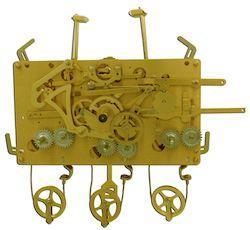
A mechanical floor clock is powered by suspended weights. As the weights slowly descend, they supply the energy that operates the timekeeping and chime mechanisms. The clock must be wound periodically by raising the weights.
Mechanical floor clocks appeal to buyers who appreciate traditional clockmaking, visible moving components, pendulum motion, and the sound produced by a mechanical chime system. Winding the clock becomes part of owning and enjoying it.
A quartz floor clock is powered by batteries. It generally requires less adjustment and does not need to be wound. Some quartz models include electronic chimes and decorative weights, although the weights may not power the clock.
Quartz may be the right choice when convenience and simple operation are the priorities. Mechanical is generally the better choice for someone who wants the complete experience of owning a traditional grandfather clock.
All of the new Hermle floor clocks currently offered by Just A Clock Collector use weight-driven mechanical movements, while our Comitti floor clocks use mechanical movements with model-specific strike and chime configurations.
HOW DOES A WEIGHT-DRIVEN GRANDFATHER CLOCK WORK?
Most mechanical grandfather clocks have three weights.
Each weight normally powers a different function:
The center weight commonly powers the timekeeping portion of the movement.
One outside weight commonly powers the chime melody.
The other outside weight commonly powers the hour strike.
The weights may look similar, but they can have different internal weights and must be installed in their designated positions. The product instructions should always be followed during setup.
As the clock runs, the weights gradually descend. Winding raises them again, restoring the stored energy needed for the next running cycle. Many traditional floor clocks are designed around an approximately eight-day operating cycle and are wound about once per week.
CABLE-DRIVEN VS. CHAIN-DRIVEN FLOOR CLOCKS
Mechanical grandfather clocks generally raise their weights using either cables or chains.
On a cable-driven clock, a winding crank or key is inserted into winding points on the dial. Turning the crank raises the weights by winding the cables onto internal drums.
This system allows the weights to be raised without directly handling the brass weight shells. Cable-driven movements are common in premium floor clocks and are frequently paired with upgraded chime systems, automatic night silence, and more elaborate case designs.
On a chain-driven clock, the owner pulls the free end of each chain downward to raise the corresponding weight. Chain-driven clocks provide the same fundamental weight-powered experience through a simpler winding arrangement.
Neither system should be judged solely by the assumption that one is “good” and the other is “bad.” The movement manufacturer, chime system, case quality, features, and overall design matter more than the winding method alone.
WESTMINSTER AND TRIPLE-CHIME GRANDFATHER CLOCKS
The chime is one of the most recognizable parts of owning a mechanical grandfather clock.
A Westminster chime clock plays the familiar Westminster melody in progressive sections throughout the quarter-hours. The complete melody is normally heard on the hour, followed by the hour strike.
A triple-chime clock gives the owner a selection of three melodies. The available choices are commonly:
Westminster
Whittington
St. Michael
Many triple-chime movements also provide a silent setting. Some allow the clock to strike only the hour without playing the full quarter-hour melody.
Westminster is an excellent choice for someone who wants the most familiar traditional clock sound. Triple chime provides more variety and the ability to change the sound according to personal preference.
When comparing models, read the exact specifications. The phrase “chiming clock” does not automatically mean the clock offers three melodies, quarter-hour chimes, volume control, or automatic night silence.
DO YOU NEED AUTOMATIC NIGHT SHUT-OFF?
Automatic night shut-off, also called automatic night silence, allows the movement to stop chiming during designated nighttime hours and resume automatically the following morning.
This can be especially valuable when a floor clock will be placed near a bedroom, in an open floor plan, or in a home where the sound may carry between floors.
Some clocks provide a manual silent setting but do not include automatic night silence. With manual silence, the owner must turn the chimes off and back on. An automatic system handles the quiet period without daily adjustment.
Neither feature affects the clock’s ability to keep time. It controls the chime and strike functions.
You can browse clocks featuring this option in our automatic night silence collection.
FOUR-ROD, NINE-ROD, AND TUBULAR-BELL CHIMES
Premium floor clocks may be distinguished by the way their chime tones are produced.
Many mechanical clocks use a series of hammers that strike tuned metal rods. A traditional four-rod movement uses a smaller chime arrangement, while a nine-rod movement can support triple-chime melodies through a larger set of rods and hammers.
At the luxury end of the category, some floor clocks use tubular bells. These long metal tubes produce a deeper, more resonant sound with greater sustain and room-filling presence.
A tubular-bell clock is not automatically the best option for every home. It is usually larger, heavier, more expensive, and considerably more commanding. For the right setting, however, the sound and visual impact can be extraordinary.
MEASURE THE CLOCK AND THE ROOM
Never choose a grandfather clock from photographs alone.
Before ordering, confirm the clock’s full height, width, and depth. Then measure the intended location carefully.
Consider more than the footprint. Check:
Ceiling height
Crown molding and baseboards
Door and hallway clearance
Stairways, landings, and turns
Nearby heating and cooling vents
Direct sunlight
Floor stability
Space required to open the front door
Access needed for winding and adjustment
A clock can fit the wall measurement and still be difficult to move through a doorway or around a stairway turn.
Also consider visual scale. A narrow clock may work well in a foyer or dining room, while a wide floor clock with columns, a large bonnet, and extensive glass may need a more substantial room.
CHOOSING A STYLE AND FINISH
Traditional grandfather clocks often feature arched bonnets, turned columns, decorative finials, moon-phase dials, beveled glass, brass components, and richly finished wood cases.
Contemporary floor clocks may use cleaner lines, open-sided cases, visible movement architecture, metal accents, contrasting finishes, and minimalist dials.
Neither style is inherently more desirable. The best choice is the clock that suits both the room and the person who will live with it.
For a traditional home, consider the existing wood tones, furniture scale, and architectural details. The clock does not need to match every piece of furniture perfectly, but it should look intentional within the room.
In a modern interior, a floor clock can provide contrast. A clean contemporary design can blend naturally with the room, while a traditional clock can become a dramatic centerpiece against a simpler background.
MOON-PHASE DIALS AND DECORATIVE FEATURES
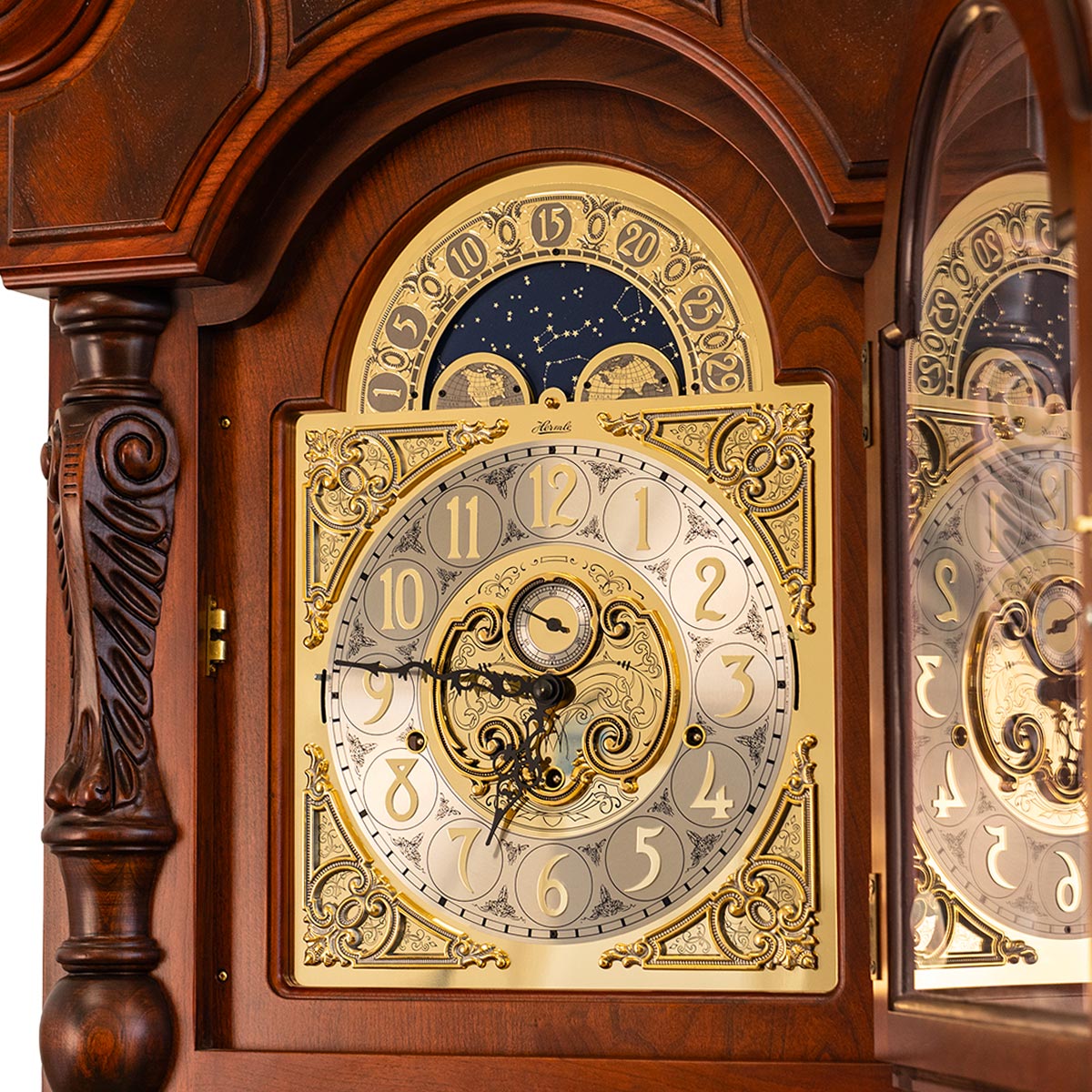
Many traditional grandfather clocks include a rotating moon-phase dial above the main time dial.
A properly set moon dial follows the lunar cycle and changes gradually as the clock runs. It is both decorative and functional, although it does not affect timekeeping.
Other features that may distinguish one clock from another include:
Etched or embossed pendulum disks
Decorative weight shells
Beveled glass
Side-access panels
Interior lighting
Mirrored case backs
Wood inlays
Burl accents
Fretted panels
Second hands
Seconds or calendar displays
These details can significantly change the appearance and price of a floor clock even when two models use similar movements.
HERMLE VS. COMITTI FLOOR CLOCKS
Hermle and Comitti are two important names to consider when shopping for a new mechanical floor clock.
Hermle offers a broad selection of traditional and transitional floor clocks. Depending on the model, features may include Westminster or triple chimes, cable-driven movements, automatic night silence, moon-phase dials, and detailed wood cases.
The Hermle floor clock collection includes models across a wide range of styles and price levels, making Hermle a strong starting point for many buyers.
Comitti floor clocks occupy a specialized luxury category, ranging from period-inspired longcase designs to limited-edition contemporary pieces. Their finely finished cases feature carefully selected woods, veneers, marquetry, inlays, hand-finished details, and distinctive dial treatments, depending on the model.
The Comitti floor clock collection is particularly well suited to buyers looking for a refined statement clock or a distinctive mechanical centerpiece. Movement and sound options vary by model, including eight-day bell-strike, Westminster-chime, and triple-chime cable movements. Current models are made to order, with handmade cabinetry or other hand-finished details where specified.
The right choice is not simply a matter of deciding which name is “better.” Compare the exact movement, chimes, dimensions, case, features, warranty terms, and design of each individual clock.
SHOULD YOU BUY A NEW OR VINTAGE GRANDFATHER CLOCK?
A new floor clock generally provides clearer specifications, factory packaging, current warranty coverage, and a more predictable purchasing process. It is often the better choice for someone who wants a particular finish, movement, feature set, or chime arrangement.
A vintage floor clock can offer a discontinued case style, established character, and a connection to an earlier period of furniture and clock design. Condition can vary substantially, however.
When considering a vintage clock, look beyond whether the clock is currently running. Ask about:
The movement manufacturer and model
The condition of the case and glass
Whether the weights, pendulum, crank, and accessories are present
Known repairs or replacement parts
The clock’s ability to run and chime through a complete cycle
How the clock will be packed or transported
Whether setup or local adjustment may be needed after delivery
A mechanical clock can require adjustment after being moved even when it operated properly before shipment.
Browse our vintage clocks to see currently available pre-owned and collectible timepieces.
HOW MUCH SHOULD YOU SPEND ON A GRANDFATHER CLOCK?
The cost of a grandfather clock depends on far more than its height.
Factors affecting price can include:
Movement type and manufacturer
Cable-driven or chain-driven construction
Westminster or triple-chime capability
Four-bell, nine-bell, or tubular-bell sound
Automatic night silence
Case materials and finish
Glass, inlays, carving, and metalwork
Interior lighting and display features
Production quantity
Country of manufacture
Brand and warranty support
Rather than beginning with the least expensive clock, begin with the features that matter most. A clock purchased only because it has the lowest price may become disappointing if it lacks the sound, size, mechanical experience, or presence you expected.
At the same time, not every buyer needs the most elaborate movement or case. A straightforward Westminster floor clock may provide exactly the traditional experience you want.
BUYING A GRANDFATHER CLOCK ONLINE
A floor clock can be purchased online successfully, but the product listing and seller matter.
Before ordering, make sure you understand:
The exact clock model and finish
The overall dimensions
The movement and winding method
The available chime melodies
Whether night silence is manual or automatic
What is included with the clock
The warranty coverage
The shipping method
Who will help if setup questions arise
The return policy
Whether original packaging must be retained
When buying a factory-new clock, purchasing from an authorized seller helps ensure that the clock is genuine and that applicable manufacturer warranty support is available.
Just A Clock Collector is an authorized seller of new Hermle and Comitti clocks. New clocks are accurately represented, carefully shipped, and supported throughout the purchasing process.
DELIVERY AND INITIAL SETUP
A mechanical floor clock must be prepared correctly before it is operated.
The cabinet should stand securely on a stable surface. The movement, pendulum, weights, and chime components must be unpacked and installed according to the manufacturer’s instructions.
The pendulum must swing evenly, and the clock may need minor adjustment after being placed in its final location. The clock should never be moved with the pendulum and weights still installed.
Do not discard the original packaging. Factory cartons and internal packing materials are designed specifically for the clock and may be required if the clock ever needs to be transported or returned for service.
A mechanical floor clock may seem intimidating at first, but the normal routine is manageable once the initial setup is complete. Most ongoing ownership consists of winding the clock, making occasional time adjustments, keeping the case clean, and arranging professional movement service when needed.
FREQUENTLY ASKED QUESTIONS
IS A FLOOR CLOCK THE SAME AS A GRANDFATHER CLOCK?
A grandfather clock is a type of floor clock. “Floor clock” is the broader category, while “grandfather clock” commonly refers to a tall, traditional pendulum clock with weights and a mechanical movement.
HOW OFTEN DO YOU WIND A GRANDFATHER CLOCK?
Many mechanical grandfather clocks are designed to be wound approximately once per week. Follow the instructions supplied with the individual movement.
DO GRANDFATHER CLOCKS CHIME ALL NIGHT?
They can, but many models include a manual silent setting or automatic night shut-off. Check the specifications because automatic night silence is not included on every clock.
IS A CABLE-DRIVEN CLOCK BETTER THAN A CHAIN-DRIVEN CLOCK?
Cable-driven systems are common in premium floor clocks, but the winding method is only one part of the clock. The movement, chime system, case, features, and overall construction should all be considered.
DO THE WEIGHTS ON A GRANDFATHER CLOCK POWER THE CLOCK?
On a traditional mechanical floor clock, yes. The descending weights provide the energy needed to operate the timekeeping, chime, and strike functions.
ARE GRANDFATHER CLOCKS DIFFICULT TO MAINTAIN?
Routine ownership is not especially difficult, but a mechanical clock does need proper setup, regular winding, careful handling, and periodic professional attention. It should be treated as a mechanical timepiece rather than ordinary furniture.
CAN A GRANDFATHER CLOCK BE PLACED ON CARPET?
It can, provided the cabinet is stable and properly supported. Thick or uneven carpet can make stabilization more difficult, so the clock’s leveling feet and anti-tip hardware should be used as instructed.
CAN YOU MOVE A GRANDFATHER CLOCK WHILE IT IS RUNNING?
No. The pendulum and weights should be removed and secured before the cabinet is moved. Moving the clock with these components installed can damage the movement, case, or glass.
FINDING THE RIGHT FLOOR CLOCK
The best grandfather clock is not necessarily the largest, most expensive, or most elaborate model.
It is the clock that provides the combination of size, appearance, movement, chimes, features, and ownership experience that feels right in your home.
Begin by measuring your space. Decide whether you want a fully mechanical clock. Choose the chime sound and nighttime features that fit your household. Then compare individual models rather than relying only on brand names or photographs.
Explore our current selection of Hermle floor clocks and Comitti floor clocks.
Questions about a particular model? Contact Just A Clock Collector before ordering. We are happy to help compare dimensions, movements, chime options, and other features so you can choose your new floor clock with confidence.

Just A Clock Collector