Why Do Whittington and St. Michael Chimes Sound So Similar?
If you have ever switched a triple-chime clock from Whittington to St. Michael and thought, “Wait…did anything actually change?” you are not alone.
A lot of people hear those two chimes and think they sound almost the same.
And honestly, on many clocks, they do.
That does not mean the clock is wrong. It does not mean your ears are bad. It simply means that Whittington and St. Michael are more alike than people expect, especially when they are played by the same clock.
The Simple Answer
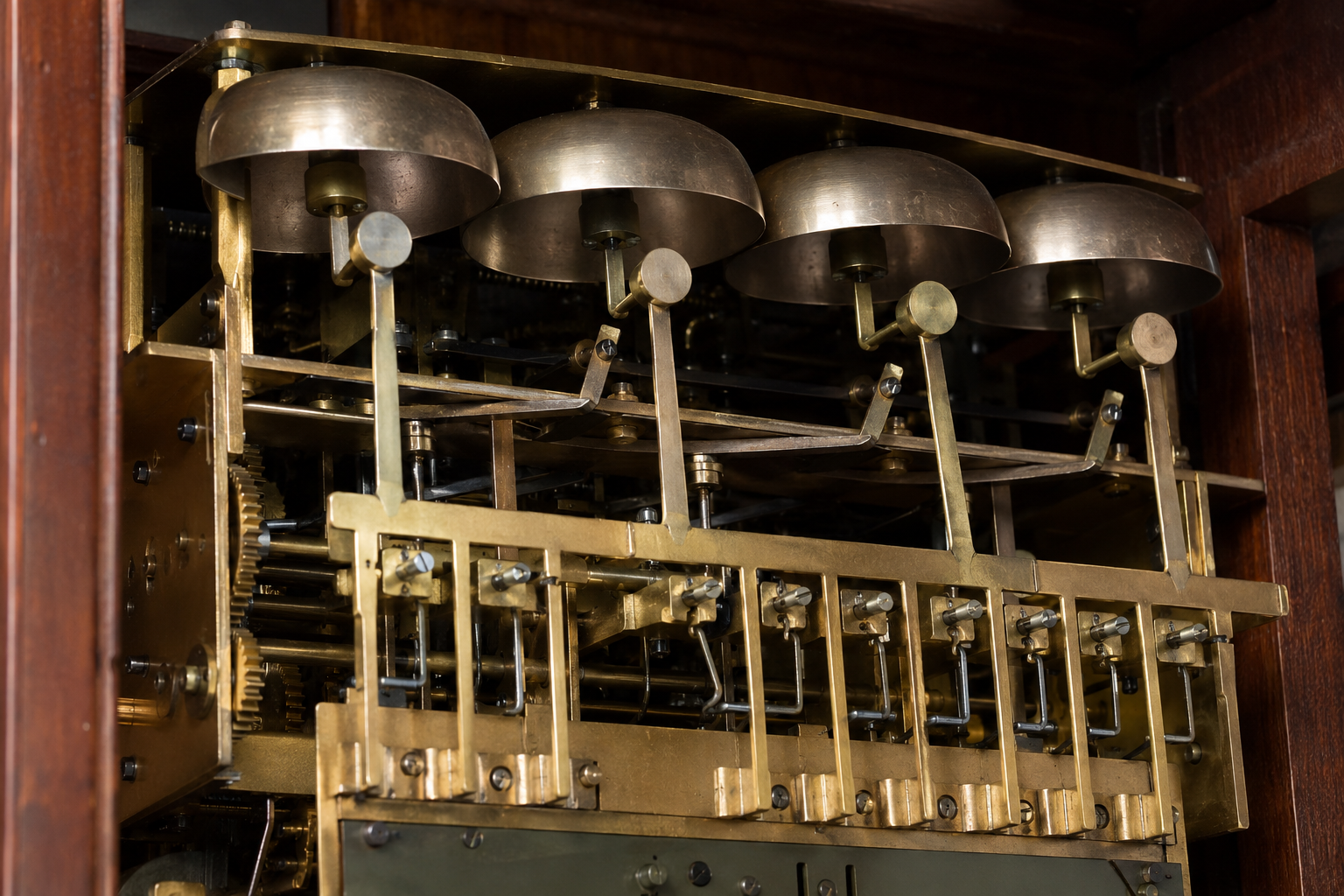
Whittington and St. Michael are different melodies, but they are often played by the same movement, through the same hammers, on the same bells or chime rods, inside the same clock case.
That matters.
The melody changes, but the voice of the clock stays the same.
Think of it like a piano. If the same piano plays two different songs, the songs may be different, but the tone of the instrument is still the same. The same is true with a mechanical clock.
The chime selector changes the sequence of notes. It does not change the entire personality of the clock’s sound system.
Melody vs. Tone
This is the key difference.
The melody is the pattern of notes being played.
The tone is the sound quality of the clock itself.
When you switch from Whittington to St. Michael, the melody changes. But the tone often remains very similar because the clock is still using the same case, same hammers, same bells or rods, and same acoustics.
That is why these two chimes can be hard to tell apart.
Your ear hears the same clock first, and the melody difference second.
Why Westminster Is Easier to Recognize
Most people can identify Westminster much more easily.
Westminster has a very familiar pattern. Even people who do not know clocks often know the sound. It is the classic chime associated with traditional clock towers, mantel clocks, wall clocks, and grandfather clocks.
Whittington and St. Michael are different.
They are both less familiar to the average listener. They also tend to feel more similar to each other than either one does to Westminster.
So when you compare all three, Westminster usually stands out immediately. Whittington and St. Michael may take more careful listening.
What Whittington Sounds Like
Whittington often has an old-world English feel.
It can sound a little more active, a little more decorative, and a little more playful than St. Michael. On some clocks, Whittington feels like it has more movement in the melody.
That makes sense given its connection to the Bow Bells of St Mary-le-Bow in London and the legend of Dick Whittington.
It has a storybook quality to it.
But on a small mantel clock or a clock with a softer chime, that character may not jump out right away.
What St. Michael Sounds Like
St. Michael often feels smoother, more stately, and more formal.
It has a graceful quality that many collectors enjoy because it is classic without being as instantly recognizable as Westminster.
St. Michael is often associated with the historic bells of St. Michael’s Church in Charleston, South Carolina. That gives it a more American historical connection compared with Whittington’s old London story.
But again, when St. Michael is played on the same clock as Whittington, the two can sound very close unless you are listening for the pattern.
Why They Can Sound Almost the Same
There are a few reasons Whittington and St. Michael can be hard to tell apart.
First, both are quarter-hour chimes. They are designed to mark the same parts of the hour.
Second, both are usually played on the same set of bells or rods inside the clock.
Third, both may use similar pitches, just in a different order or pattern.
Fourth, the clock case affects the sound. A heavy wood case can make both chimes sound warm and blended. A smaller case can make the melodies sound compressed. A clock with weaker tone may make the differences harder to hear.
Finally, most people are simply more familiar with Westminster. Since Whittington and St. Michael are less commonly heard, the ear does not always separate them quickly.
How to Tell Them Apart
The best way to hear the difference is to listen to the full chime at the top of the hour.
Do not judge them only by the first quarter. The short quarter-hour phrase may not be enough for your ear to catch the difference.
Instead, compare them at the hour, when the full melody plays.
Switch the selector to Whittington and let the clock play the full hour sequence. Then switch to St. Michael and listen again at the next hour, or carefully advance the minute hand if the clock allows it and you know how to do so safely.
Listen for the flow of the melody rather than the tone.
Whittington often feels a little busier or more old-world.
St. Michael often feels a little smoother and more formal.
That is not a technical music lesson. It is just a practical way to hear the difference.
Why This Matters to Collectors
For collectors, the difference between Whittington and St. Michael is part of the fun.
A triple-chime clock gives you choices. Westminster may be the most famous, but Whittington and St. Michael give the clock more personality.
Some collectors love Whittington because it feels connected to old London and the Bow Bells.
Others prefer St. Michael because it feels elegant, historic, and less common.
Neither one is automatically better. They simply give the clock a different mood.
The Bottom Line
So why do Whittington and St. Michael sound so similar?
Because they are different melodies being played by the same instrument.
The clock’s case, hammers, bells, rods, and movement all shape the sound. When the physical clock stays the same, the overall tone stays the same too.
The difference is in the melody pattern, not the entire sound of the clock.
Once you know what to listen for, the distinction becomes easier.
Whittington often feels more old-world and lively.
St. Michael often feels smoother and more stately.
But if they sound close to you, do not worry.
You are hearing exactly what many clock owners hear: two beautiful traditional chimes, played by the same mechanical voice.

Just A Clock Collector